

"What The...?!?!"
{A Thoroughly Theological Defense of Astonishment :) }

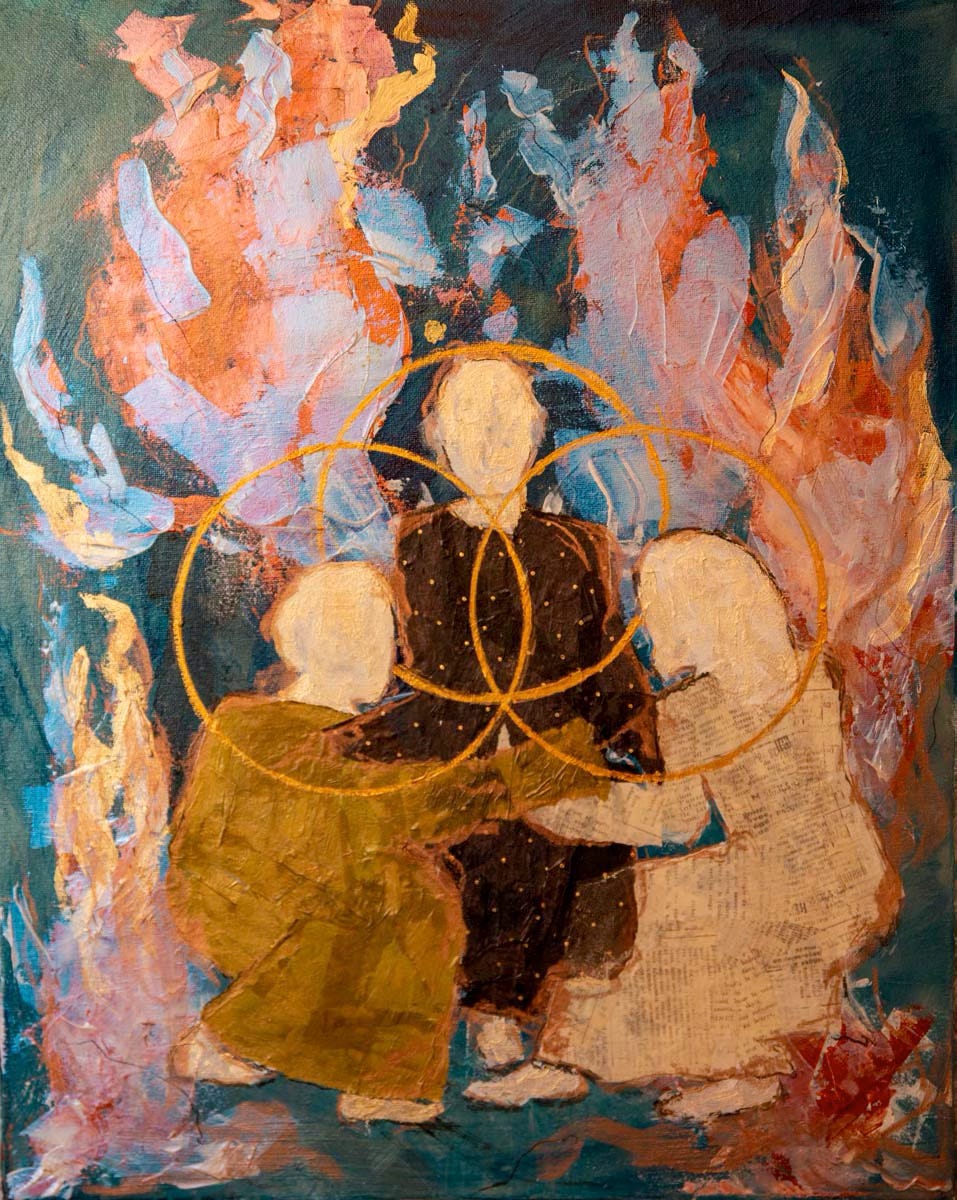
(“The Trinity” by Sheila Atchley)
I’m going to tell you something that will either delight you or make your third-grade Sunday school teacher cry (and honestly, I’m at peace with either outcome.)
The Hebrew word for manna is, more or less, a shrug with a question mark on it. “Man hu.” Scholars debate its exact roots (because of course they do…scholarsgonnascholar), but the working translation that has survived millennia of study is simply: “What is it?”
The Israelites looked down at this fine, frost-like, honey-wafer mystery on the desert sand and said, in essence, “what in the actual world is this thing?!” The food was so categorically new, so outside any prior frame of reference, that the best language they had was…bewilderment.
They named it after their own amazement. The bread from heaven was called What Is This. One academic commentary I came across, and I love this man, bless him, suggested it was essentially a vernacular term. Like the English slang “whatzit?”
So yes. I stand by my original position. In the spirit of our heritage (our loud, passionate, full-color, Psalms-were-set-to-bar-songs, Miriam-grabbed-a-tambourine heritage) a few of those Hebrew couples absolutely looked at each other and said the ancient equivalent of “What the heck is THIS?”
We have been handed, somehow, this limp and laundered version of our spiritual ancestors. We picture them shuffling through the desert in beige flaxen-linen, speaking in hushed reverence about “the provision of the Lordt.”
I don’t buy it for one minute. These were people who built a golden calf because Moses was forty days late coming down a mountain. These were people who wept so loudly for meat that it became a history-altering crisis of leadership (Numbers 11).
These were people. They were real, breathing, (very) dramatic humans, for whom the gap between despair and ecstasy was sometimes measured in a single afternoon.
They were me. ha.
And when the dew lifted one morning and the ground was covered in something they had never seen before, never tasted before, never even had a category for, I promise you, it was not a holy hushed moment. It was the ancient near-eastern equivalent of everyone screaming in all-caps on the group text. The exclamation points were understood.
Man huuuuuuuuuuuu. Manna. What IS this?
This matters to me. It matters more than a little, because the texture of our perceived spiritual heritage shapes the texture of our present faith. If we believe we come from stoic, stone-faced, subdued, mostly reverent people, we will practice a stone-faced, subdued, pseudo-reverent faith. But if we understand that we come from people who were passionate and wide-eyed and unguarded in their astonishment, we give ourselves permission to be undone by grace.
We give ourselves permission to be caught off guard by God. We give ourselves permission to say, out loud, “What the HECK?” (I do it all the time.)
His Name Is Actually “Surprise”
Here is where I need you to stay with me for just a moment, because this is the part that made me stop and stare.
Isaiah 9:6. You know it. You’ve sung it every December since you were small.
“And his name shall be called Wonderful Counselor...”
The Hebrew word translated “Wonderful” is pele.(ּפֶלֶא). Scholars describe pele this way: “a miracle, a marvel, a wonder...the extraordinary, the astonishing, the tremendously significant...always used in connection with God.”
It doesn’tmean “lovely.” It doesn’t mean “impressive.” It carries the impact of something so far outside the expected order of things, that it produces an unexpected gasp. A dropped jaw. Pele is the ancient Hebrew word for the thing that makes you say “what the heck.”
His name is literally Astonishing. His name is “You Will Not See This Coming.” His name is “Hold my wine - y’all watch this.” His name, given by the Prophet eight centuries before Bethlehem, was already promising us: “I will be more than you imagine, more than you can prepare for, more than your most generous theological system can contain.”
Pele. Surprise. Every. Single. Time.
Now sit with this (please) because here is where manna and Wonderful collide in a way that takes my breath: The Holy Spirit’s ongoing work is to feed us on a revelation of Jesus that is forever old yet new, always mysterious yet knowable. Jesus said it plainly in John 6, when the crowd tried to use the memory of Moses’ manna against Him: “My Father gives you the true bread from heaven...I am the bread of life.”
He wasn’t dismissing the manna. He was saying the manna was always pointing here. To this. To Him. The bread was called “What On Earth Is This” because it was always meant to make you ask that very question. And the One the man-hu represented named Himself “Astonishing.”
Reliable Surprise Is Not a Contradiction
I want to be careful here, because the life of faith is not built on a steady stream of mystical buzz and bubbles. There are a thousand long Mondays. There are seasons when the dew lifts and the ground is just...ground. Familiar. I find nothing new.
And here is the hard-won theology I keep returning to: God is not unpredictable. He is reliably surprising. The two are not a contradiction; they are a paradox, and the Christian life is made almost entirely of those. He is faithful and free. He is the same yesterday, today, and forever and He makes all things new. He is the Ancient of Days who calls Himself “What You Won’t See Coming.”
The revelation of the finished work of Jesus is the most stable ground under my feet, yet it is simultaneously the thing that has surprised me more thoroughly than anything else in my whole, almost 60-year-old life. Every time I assume I have mapped most of the territory of grace, I round a corner into a Promise Land I have never stood in before.
He is always better than we know. Not sometimes better. Always. Not better in proportion to our goodness, better in proportion to His. This is the thing that reduces me, regularly, to the spiritual equivalent of man hu: “What IS this?” What in the actual world is this grace I keep finding?
The Old Camp Meeting Song Knew Something
C. B. Widmeyer wrote “Come and Dine” in 1906. Not for a cathedral, not for a recital, but for a sermon. He’d been sitting with John 21: the exhausted disciples, all night on the water with nothing to show for it, and there on the shore is Jesus. With fish already on the fire. Bread already prepared.
I do not believe Jesus just “spoke that meal into existence”. I do not think He “Shazam’d” it. He gathered His ingredients, He made a fire, and He cooked for His friends.
Point being, the meal was already made before they ever came in from the cold. He had anticipated their need and made an incarnational, physical effort to meet it. That’s the lyric-beneath-the-lyric of the whole song. That’s what the camp meeting saints were actually singing when they belted that chorus some sweaty August, with sawdust under their shoes:
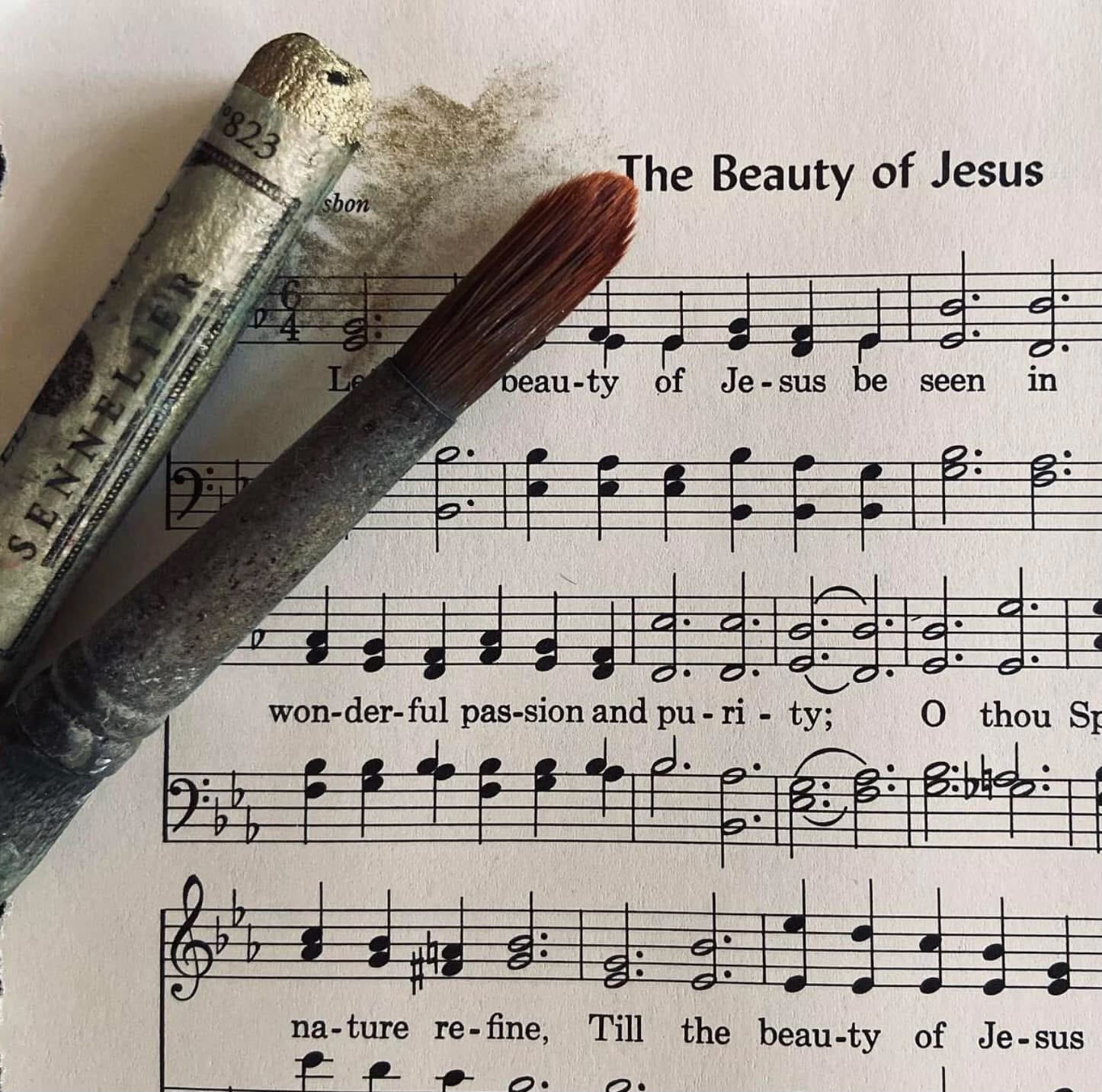
Jesus has a table spread / Where the saints of God are fed/He invites His chosen people Come and Dine...With His manna He doth feed /And supplies our every need...
Manna. “Whattheheck” bread, offered again, only this time at a table spread in the very presence of the risen Christ, and most importantly on the other side of the cross. Here’s what I need you to notice: Jesus made breakfast for the man who had denied Him three times. Yet He didn’t lead with that fact. Didn’t withhold the fish until the apology came. Fed him first, and then, only then, asked three times: “Do you love me?” Once for each denial.
Restoration disguised as a puzzling question. That is not a tidy, manageable grace. That is a grace that makes you say, quietly, undone, with no better theological language available…”what the heck.”
And every now and then I wish the church would still sing the old camp meeting song “Come and Dine”. And every now and then, the song should have a little parenthetical moment. Every now and then, I think, someone should be allowed to lean over to the person in the next folding chair and whisper, “Do you SEE this? Do you understand what is happening here? What the heck is this grace?”
Because that’s the appropriate response. That is the theologically accurate response. Not a neat, tidy, systematic apologetic, but the wide-eyed, undone, “I cannot fully account for this goodness” response.
How to Practice Holy Astonishment
I want to close with something practical, because I am married to a man who passionately believes that all theology should have boots on it.
I’ve found that holy astonishment is not a feeling you work up. It’s a posture you practice. It comes from deliberately approaching grace with your need, not your expertise. It comes from resisting the temptation to domesticate what God has done by categorizing it, explaining it, and moving on to the next of the five doctrinal points.
The Israelites were instructed not to hoard the manna. Not to stockpile it. Not to build systems around it. Each morning, new. Each morning, man hu. Every sunrise, an invitation to be freshly surprised by provision.
This is, I think, the posture of the grace-formed life: not arriving in the morning with yesterday’s manna in your fist, having thoroughly studied it. But arriving open-handed, needy enough to be astonished again. He is pele. He is the Astonishing One.
He has set a table. He has prepared the meal. He had planned your total restoration - by means of His own death on a cross - before you denied Him and fled to the cold, damp fishing boat.
Come and dine. (What the heck?!) {parentheses very much mine}
What the heck, indeed! You have made my Monday morning, shifted my heart. What a gift!